 Add to Chrome
 Add to Firefox
 Add to Edge
FilDeep: Learning Large Deformations of Elastic-Plastic Solids with Multi-Fidelity Data
Jan 15, 2026
The scientific computation of large deformations in elastic-plastic solids is crucial in various manufacturing applications. Traditional numerical methods exhibit several inherent limitations, prompting Deep Learning (DL) as a promising alternative. The effectiveness of current DL techniques typically depends on the availability of high-quantity and high-accuracy datasets, which are yet difficult to obtain in large deformation problems. During the dataset construction process, a dilemma stands between data quantity and data accuracy, leading to suboptimal performance in the DL models. To address this challenge, we focus on a representative application of large deformations, the stretch bending problem, and propose FilDeep, a Fidelity-based Deep Learning framework for large Deformation of elastic-plastic solids. Our FilDeep aims to resolve the quantity-accuracy dilemma by simultaneously training with both low-fidelity and high-fidelity data, where the former provides greater quantity but lower accuracy, while the latter offers higher accuracy but in less quantity. In FilDeep, we provide meticulous designs for the practical large deformation problem. Particularly, we propose attention-enabled cross-fidelity modules to effectively capture long-range physical interactions across MF data. To the best of our knowledge, our FilDeep presents the first DL framework for large deformation problems using MF data. Extensive experiments demonstrate that our FilDeep consistently achieves state-of-the-art performance and can be efficiently deployed in manufacturing.

ViTE: Virtual Graph Trajectory Expert Router for Pedestrian Trajectory Prediction
Nov 15, 2025Pedestrian trajectory prediction is critical for ensuring safety in autonomous driving, surveillance systems, and urban planning applications. While early approaches primarily focus on one-hop pairwise relationships, recent studies attempt to capture high-order interactions by stacking multiple Graph Neural Network (GNN) layers. However, these approaches face a fundamental trade-off: insufficient layers may lead to under-reaching problems that limit the model's receptive field, while excessive depth can result in prohibitive computational costs. We argue that an effective model should be capable of adaptively modeling both explicit one-hop interactions and implicit high-order dependencies, rather than relying solely on architectural depth. To this end, we propose ViTE (Virtual graph Trajectory Expert router), a novel framework for pedestrian trajectory prediction. ViTE consists of two key modules: a Virtual Graph that introduces dynamic virtual nodes to model long-range and high-order interactions without deep GNN stacks, and an Expert Router that adaptively selects interaction experts based on social context using a Mixture-of-Experts design. This combination enables flexible and scalable reasoning across varying interaction patterns. Experiments on three benchmarks (ETH/UCY, NBA, and SDD) demonstrate that our method consistently achieves state-of-the-art performance, validating both its effectiveness and practical efficiency.
D2R: dual regularization loss with collaborative adversarial generation for model robustness
Jun 08, 2025The robustness of Deep Neural Network models is crucial for defending models against adversarial attacks. Recent defense methods have employed collaborative learning frameworks to enhance model robustness. Two key limitations of existing methods are (i) insufficient guidance of the target model via loss functions and (ii) non-collaborative adversarial generation. We, therefore, propose a dual regularization loss (D2R Loss) method and a collaborative adversarial generation (CAG) strategy for adversarial training. D2R loss includes two optimization steps. The adversarial distribution and clean distribution optimizations enhance the target model's robustness by leveraging the strengths of different loss functions obtained via a suitable function space exploration to focus more precisely on the target model's distribution. CAG generates adversarial samples using a gradient-based collaboration between guidance and target models. We conducted extensive experiments on three benchmark databases, including CIFAR-10, CIFAR-100, Tiny ImageNet, and two popular target models, WideResNet34-10 and PreActResNet18. Our results show that D2R loss with CAG produces highly robust models.
Unisoma: A Unified Transformer-based Solver for Multi-Solid Systems
Jun 06, 2025Multi-solid systems are foundational to a wide range of real-world applications, yet modeling their complex interactions remains challenging. Existing deep learning methods predominantly rely on implicit modeling, where the factors influencing solid deformation are not explicitly represented but are instead indirectly learned. However, as the number of solids increases, these methods struggle to accurately capture intricate physical interactions. In this paper, we introduce a novel explicit modeling paradigm that incorporates factors influencing solid deformation through structured modules. Specifically, we present Unisoma, a unified and flexible Transformer-based model capable of handling variable numbers of solids. Unisoma directly captures physical interactions using contact modules and adaptive interaction allocation mechanism, and learns the deformation through a triplet relationship. Compared to implicit modeling techniques, explicit modeling is more well-suited for multi-solid systems with diverse coupling patterns, as it enables detailed treatment of each solid while preventing information blending and confusion. Experimentally, Unisoma achieves consistent state-of-the-art performance across seven well-established datasets and two complex multi-solid tasks. Code is avaiable at \href{this link}{https://github.com/therontau0054/Unisoma}.
LaDEEP: A Deep Learning-based Surrogate Model for Large Deformation of Elastic-Plastic Solids
Jun 06, 2025Scientific computing for large deformation of elastic-plastic solids is critical for numerous real-world applications. Classical numerical solvers rely primarily on local discrete linear approximation and are constrained by an inherent trade-off between accuracy and efficiency. Recently, deep learning models have achieved impressive progress in solving the continuum mechanism. While previous models have explored various architectures and constructed coefficient-solution mappings, they are designed for general instances without considering specific problem properties and hard to accurately handle with complex elastic-plastic solids involving contact, loading and unloading. In this work, we take stretch bending, a popular metal fabrication technique, as our case study and introduce LaDEEP, a deep learning-based surrogate model for \textbf{La}rge \textbf{De}formation of \textbf{E}lastic-\textbf{P}lastic Solids. We encode the partitioned regions of the involved slender solids into a token sequence to maintain their essential order property. To characterize the physical process of the solid deformation, a two-stage Transformer-based module is designed to predict the deformation with the sequence of tokens as input. Empirically, LaDEEP achieves five magnitudes faster speed than finite element methods with a comparable accuracy, and gains 20.47\% relative improvement on average compared to other deep learning baselines. We have also deployed our model into a real-world industrial production system, and it has shown remarkable performance in both accuracy and efficiency.
AFCL: Analytic Federated Continual Learning for Spatio-Temporal Invariance of Non-IID Data
May 18, 2025Federated Continual Learning (FCL) enables distributed clients to collaboratively train a global model from online task streams in dynamic real-world scenarios. However, existing FCL methods face challenges of both spatial data heterogeneity among distributed clients and temporal data heterogeneity across online tasks. Such data heterogeneity significantly degrades the model performance with severe spatial-temporal catastrophic forgetting of local and past knowledge. In this paper, we identify that the root cause of this issue lies in the inherent vulnerability and sensitivity of gradients to non-IID data. To fundamentally address this issue, we propose a gradient-free method, named Analytic Federated Continual Learning (AFCL), by deriving analytical (i.e., closed-form) solutions from frozen extracted features. In local training, our AFCL enables single-epoch learning with only a lightweight forward-propagation process for each client. In global aggregation, the server can recursively and efficiently update the global model with single-round aggregation. Theoretical analyses validate that our AFCL achieves spatio-temporal invariance of non-IID data. This ideal property implies that, regardless of how heterogeneous the data are distributed across local clients and online tasks, the aggregated model of our AFCL remains invariant and identical to that of centralized joint learning. Extensive experiments show the consistent superiority of our AFCL over state-of-the-art baselines across various benchmark datasets and settings.
ACU: Analytic Continual Unlearning for Efficient and Exact Forgetting with Privacy Preservation
May 18, 2025The development of artificial intelligence demands that models incrementally update knowledge by Continual Learning (CL) to adapt to open-world environments. To meet privacy and security requirements, Continual Unlearning (CU) emerges as an important problem, aiming to sequentially forget particular knowledge acquired during the CL phase. However, existing unlearning methods primarily focus on single-shot joint forgetting and face significant limitations when applied to CU. First, most existing methods require access to the retained dataset for re-training or fine-tuning, violating the inherent constraint in CL that historical data cannot be revisited. Second, these methods often suffer from a poor trade-off between system efficiency and model fidelity, making them vulnerable to being overwhelmed or degraded by adversaries through deliberately frequent requests. In this paper, we identify that the limitations of existing unlearning methods stem fundamentally from their reliance on gradient-based updates. To bridge the research gap at its root, we propose a novel gradient-free method for CU, named Analytic Continual Unlearning (ACU), for efficient and exact forgetting with historical data privacy preservation. In response to each unlearning request, our ACU recursively derives an analytical (i.e., closed-form) solution in an interpretable manner using the least squares method. Theoretical and experimental evaluations validate the superiority of our ACU on unlearning effectiveness, model fidelity, and system efficiency.
Unified Spatial-Temporal Edge-Enhanced Graph Networks for Pedestrian Trajectory Prediction
Feb 04, 2025Pedestrian trajectory prediction aims to forecast future movements based on historical paths. Spatial-temporal (ST) methods often separately model spatial interactions among pedestrians and temporal dependencies of individuals. They overlook the direct impacts of interactions among different pedestrians across various time steps (i.e., high-order cross-time interactions). This limits their ability to capture ST inter-dependencies and hinders prediction performance. To address these limitations, we propose UniEdge with three major designs. Firstly, we introduce a unified ST graph data structure that simplifies high-order cross-time interactions into first-order relationships, enabling the learning of ST inter-dependencies in a single step. This avoids the information loss caused by multi-step aggregation. Secondly, traditional GNNs focus on aggregating pedestrian node features, neglecting the propagation of implicit interaction patterns encoded in edge features. We propose the Edge-to-Edge-Node-to-Node Graph Convolution (E2E-N2N-GCN), a novel dual-graph network that jointly models explicit N2N social interactions among pedestrians and implicit E2E influence propagation across these interaction patterns. Finally, to overcome the limited receptive fields and challenges in capturing long-range dependencies of auto-regressive architectures, we introduce a transformer encoder-based predictor that enables global modeling of temporal correlation. UniEdge outperforms state-of-the-arts on multiple datasets, including ETH, UCY, and SDD.
Memory-Efficient Gradient Unrolling for Large-Scale Bi-level Optimization
Jun 20, 2024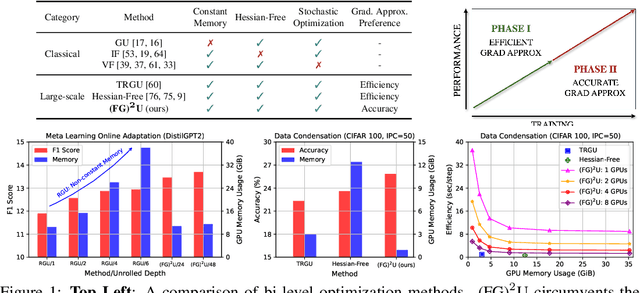
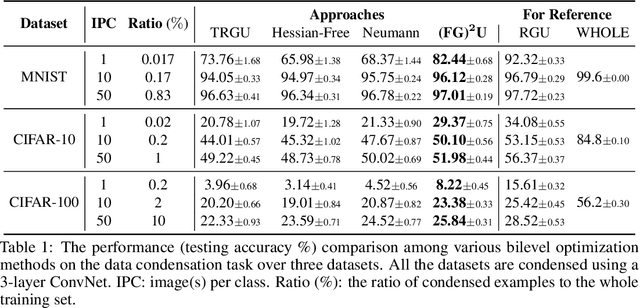
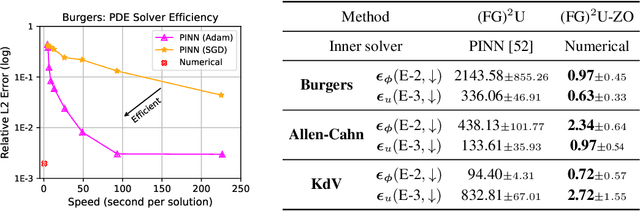
Bi-level optimization (BO) has become a fundamental mathematical framework for addressing hierarchical machine learning problems. As deep learning models continue to grow in size, the demand for scalable bi-level optimization solutions has become increasingly critical. Traditional gradient-based bi-level optimization algorithms, due to their inherent characteristics, are ill-suited to meet the demands of large-scale applications. In this paper, we introduce $\textbf{F}$orward $\textbf{G}$radient $\textbf{U}$nrolling with $\textbf{F}$orward $\textbf{F}$radient, abbreviated as $(\textbf{FG})^2\textbf{U}$, which achieves an unbiased stochastic approximation of the meta gradient for bi-level optimization. $(\text{FG})^2\text{U}$ circumvents the memory and approximation issues associated with classical bi-level optimization approaches, and delivers significantly more accurate gradient estimates than existing large-scale bi-level optimization approaches. Additionally, $(\text{FG})^2\text{U}$ is inherently designed to support parallel computing, enabling it to effectively leverage large-scale distributed computing systems to achieve significant computational efficiency. In practice, $(\text{FG})^2\text{U}$ and other methods can be strategically placed at different stages of the training process to achieve a more cost-effective two-phase paradigm. Further, $(\text{FG})^2\text{U}$ is easy to implement within popular deep learning frameworks, and can be conveniently adapted to address more challenging zeroth-order bi-level optimization scenarios. We provide a thorough convergence analysis and a comprehensive practical discussion for $(\text{FG})^2\text{U}$, complemented by extensive empirical evaluations, showcasing its superior performance in diverse large-scale bi-level optimization tasks.
Doubly Stochastic Models: Learning with Unbiased Label Noises and Inference Stability
Apr 01, 2023Random label noises (or observational noises) widely exist in practical machine learning settings. While previous studies primarily focus on the affects of label noises to the performance of learning, our work intends to investigate the implicit regularization effects of the label noises, under mini-batch sampling settings of stochastic gradient descent (SGD), with assumptions that label noises are unbiased. Specifically, we analyze the learning dynamics of SGD over the quadratic loss with unbiased label noises, where we model the dynamics of SGD as a stochastic differentiable equation (SDE) with two diffusion terms (namely a Doubly Stochastic Model). While the first diffusion term is caused by mini-batch sampling over the (label-noiseless) loss gradients as many other works on SGD, our model investigates the second noise term of SGD dynamics, which is caused by mini-batch sampling over the label noises, as an implicit regularizer. Our theoretical analysis finds such implicit regularizer would favor some convergence points that could stabilize model outputs against perturbation of parameters (namely inference stability). Though similar phenomenon have been investigated, our work doesn't assume SGD as an Ornstein-Uhlenbeck like process and achieve a more generalizable result with convergence of approximation proved. To validate our analysis, we design two sets of empirical studies to analyze the implicit regularizer of SGD with unbiased random label noises for deep neural networks training and linear regression.